Navigational Matrix for High-Tier Ocean Logistics: Technical Procurement and Spatial Operations
Premium cruise travel guide. The organization of premium maritime voyages necessitates a meticulous comprehension of marine logistics, hydrodynamic comfort parameters, and spatial asset management. Within the contemporary matrix of elite global mobility, the acquisition of a superior seafaring experience has advanced beyond the simple purchasing of high-tier suites. Discriminating travelers frequently observe that substantial financial investment alone cannot insulate a voyage from structural disruptions or micro-logistical friction. True operational continuity across a complex oceanic itinerary demands an analytical methodology that prioritizes structural insulation over superficial promotional metrics.
Many maritime itineraries are assembled via a disconnected procurement model, where flights, port transfers, and shipboard allocations are negotiated through separate corporate channels. This fragmented method introduces serious structural vulnerabilities, as independent marine operators and port authorities rarely communicate across jurisdictional boundaries. A minor mechanical or weather disruption at a primary fueling lock can propagate instantly through a coastal schedule, invalidating downstream shore arrangements. Consequently, strategic itinerary design must transition toward an integrated systems model that evaluates geography, time, and support assets as interdependent components.
Establishing long-term resilience within a high-tier voyage requires realistic stress testing of every transit phase, port interface, and maritime service layer. Planners must assess changing regional maritime regulations, localized port labor dynamics, and seasonal weather patterns with absolute professional detachment. This comprehensive manual offers an in-depth examination of elite cruise architecture, delivering structured models, operational metrics, and adaptive strategies. These systems are engineered to shield significant capital investments from fragmentation while preserving the cognitive focus and physical well-being of the traveler.
Understanding “premium cruise travel guide”
Deconstructing the Analytical Framework
The structural knowledge within a professional premium cruise travel guide is frequently reduced by mass consumer publications to basic cataloging of shipboard menus and cabin sizes. This superficial interpretation ignores the underlying operational logistics, maritime labor dynamics, and mechanical realities that dictate high-tier seafaring success. A meticulous analysis of premium voyage design must focus on the active mitigation of transition friction and the preservation of temporal value. The core objective is ensuring that the traveler’s micro-environment continuously supports personal privacy, physical security, and intellectual focus.
The Vulnerability of Disconnected Travel Components
A primary structural failure in basic cruise planning is the assumption that booking a premium stateroom independently yields a flawless journey. When the marine booking is isolated from the necessary aviation and ground transport links, the entire journey remains vulnerable to systemic disconnections.
An expensive suite reservation on an ultra-luxury expedition ship cannot guarantee fulfillment if the flight path lacks defensive scheduling buffers. Therefore, an analytical planning process must treat the port-interface phase as a critical risk zone rather than a simple administrative detail.
Operational Policy Variance and Friction Points
Furthermore, premium maritime vulnerability is heightened by a reliance on standard commercial ticket contracts that heavily favor the operating cruise line. High-end lines enforce strict cancellation schedules and maintain the unilateral legal right to alter itineraries due to weather or port congestion.
Without proactive contractual review or the secondary allocation of defensive capital, travelers are frequently left exposed to sudden route modifications. This exposure compromises corporate schedules, complicates the management of sensitive luggage assets, and generates severe mental fatigue.
Preserving Human Capital and Spatial Focus
Understanding these operational variables allows experienced planners to decouple the nominal cost of a voyage from its actual functional utility. An itinerary that prioritizes rapid port alternation over human acclimatization introduces significant physical strain that diminishes the value of premium shipboard spaces.
By analyzing how local harbor constraints, fuel logistics, and national customs protocols interact, planners can build protective buffers into the schedule. This systematic methodology transforms maritime coordination from a series of stressful transactions into a structured discipline that preserves human capital.
Deep Contextual Background: The Evolution of Elite Ocean Transits
The Historical Shift from Transit to Leisure
The historical trajectory of premium ocean travel has shifted from low-velocity, functional transoceanic migration to hyper-luxury, destination-dense cruising. In the nineteenth and early twentieth centuries, elite sea travel was defined by the transatlantic ocean liner paradigm, where wealthy families traveled across oceans.
These journeys were executed via deeply stabilized, high-displacement vessels that naturally built significant chronological stability into the schedule. The voyage pace was deliberate, allowing passengers to gradually adjust to changing temporal, linguistic, and cultural environments over many consecutive days at sea.
The Modern Consolidation and Acceleration
The mid-twentieth century expansion of commercial jet aviation rapidly obsolete functional passenger liners, forcing maritime operators to reinvent vessels as floating leisure resorts. Marine engineering pivoted toward maximizing onboard real estate and expanding superstructure heights, which altered the hydrodynamic handling profiles of modern cruise ships.
Concurrently, the compression of travel schedules minimized the time allotted for port turnarounds to maximize asset deployment and corporate revenue cycles. The margins for error within these schedules were heavily reduced, rendering journeys vulnerable to minor regional infrastructural disruptions.
The Digital Aggregation Matrix
The modern maritime environment has been profoundly reshaped by the rise of digital global distribution networks and centralized algorithmic booking interfaces. These technologies create an illusion of total logistical simplicity, encouraging travelers to combine complex itinerary variants without evaluating localized harbor risks.
Today, this digitized environment faces rising harbor congestion, volatile maritime weather patterns, and persistent localized labor shortages across major port agencies. This combination demands a return to deliberate, structural itinerary analysis to prevent high-end schedules from collapsing under sudden operational stress.
Conceptual Frameworks and Maritime Mental Models
The Hydrodynamic Stabilization Index
This mental model requires all maritime options to be evaluated by calculating the precise relationship between hull displacement, stabilizer technology, and regional wave patterns. A vessel with a high superstructure and low draft operating in open, turbulent waters yields a poor stabilization index.
By mapping an entire voyage across this index, planners can identify hidden sources of physical discomfort and motion fatigue. This mapping allows them to substitute high-friction open-ocean legs with protected coastal channels or superior hull configurations.
The Port Interface Custody Model
This framework treats the cruise passenger as an asset that must remain within continuous, high-security, vetted environments during the transition from land to sea. Secure environments include private terminal lounges, dedicated tender vessels, escorted ground transport, and verified shipboard security zones.
An itinerary gap occurs whenever this custody chain breaks, exposing the traveler to unvetted public concourses or unreliable local transport providers. The objective of schedule construction under this model is to ensure that the release from one secure asset links directly to the acquisition of the next.
The Spatial Density Ratio
This metric measures the balance between total gross tonnage and total passenger capacity within a specific cruise vessel design. Premium travel should maximize this ratio, ensuring that the individual experiences uncrowded public spaces, rapid elevator access, and personalized service levels.
By prioritizing ships that maintain low passenger densities, the planner insulates the traveler’s attention from crowd-induced friction. This protection preserves the exclusive atmosphere that characterizes genuine premium maritime travel.
Key Categories of Premium Vessel Architecture
Mega-Resort Vessels with Exclusive Enclaves
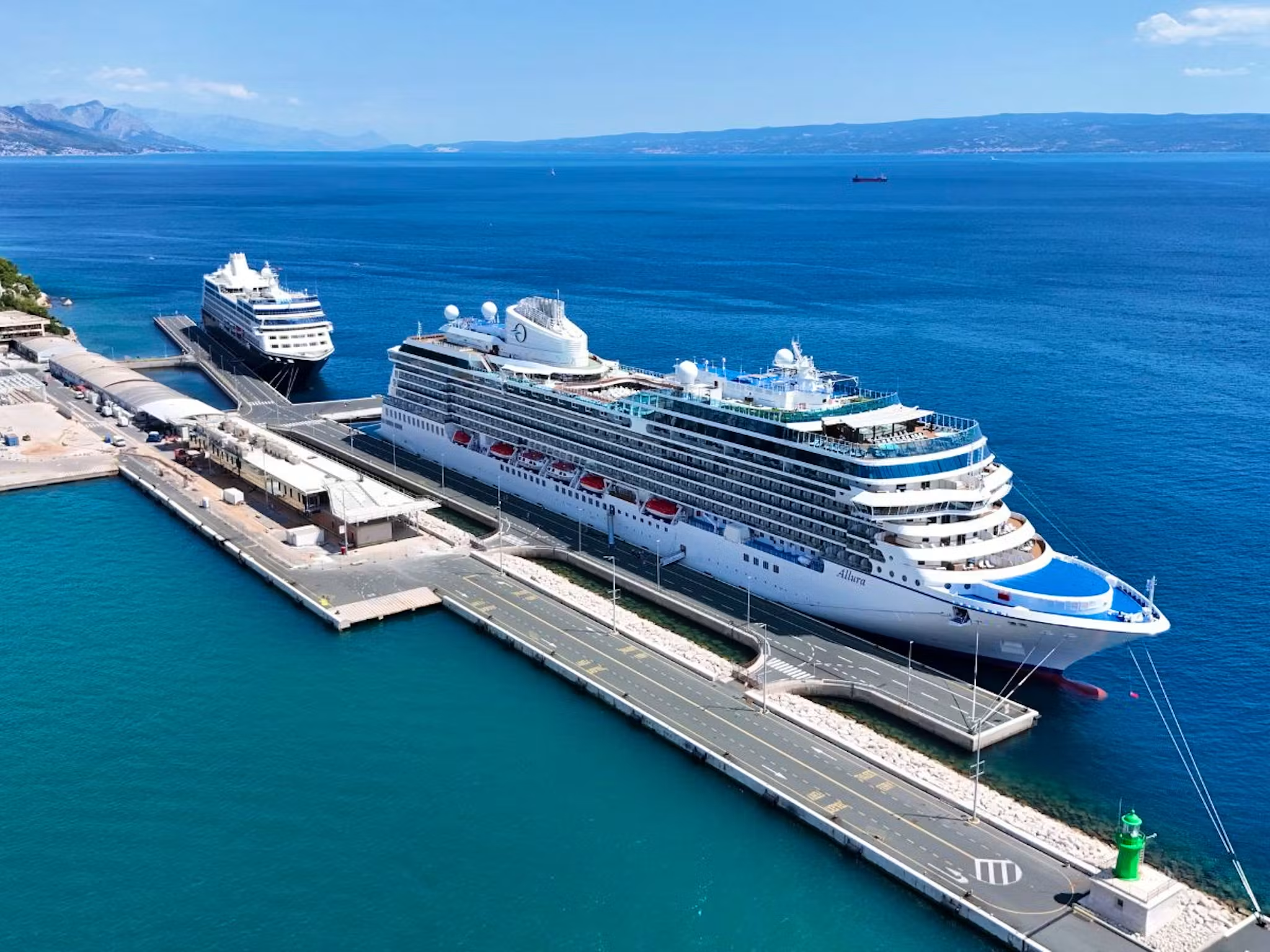
This architecture features massive hulls containing thousands of passengers, but isolates premium travelers within a restricted, high-security keycard enclave at the superstructure summit. Examples include the specialized ship-within-a-ship concepts operated by major global cruise corporations.
While this model provides access to massive entertainment assets and extensive culinary variety, it exposes the traveler to crowded public areas during embarkation.
Boutique Luxury Ocean Cruisers
This strategy involves utilizing medium-sized vessels designed specifically to carry fewer than five hundred passengers, optimizing the spatial density ratio completely. These ships can access smaller, historic harbors that are completely inaccessible to mass-market mega-ships, bypassing industrial port terminals.
This configuration maximizes cultural immersion and eliminates terminal crowding, though it introduces greater vulnerability to open-ocean swell motion due to lower displacement.
Luxury Expedition Hulls
This complex structure utilizes ice-strengthened polar hulls equipped with advanced dynamic positioning systems, designed for deep exploration of remote regions like Antarctica. Because these operations are highly dependent on localized ice dynamics, strict environmental regulations, and remote fueling networks, they are structurally fragile.
A sudden shift in polar wind patterns can invalidate a scheduled landing site instantly, forcing immediate re-routing to alternative coastal coordinates.
Evaluation of Premium Cruise Architectures
The table below outlines the operational trade-offs inherent in different high-tier maritime architectures.
Realistic Decision Logic
When evaluating a multi-port cruise proposal, a planner must calculate the total transit time required under a worst-case scenario. If the gap between flight arrival and ship sailaway drops below the combined time of potential baggage delays, customs surges, and port traffic, the schedule must be rejected. The planner must then choose between extending the pre-cruise hotel buffer or securing a vessel with more flexible embarkation windows.
Detailed Real-World Scenarios and Operational Stress Testing
Scenario A: The Mediterranean Industrial Port Congestion Crisis
A traveler schedules a back-to-back boutique cruise through the Greek Isles, with embarkation occurring at an industrial port near Athens.
Constraints and Local Factors
The port is simultaneously processing three mass-market mega-vessels, taxicab unions are striking, and air temperatures exceed one hundred degrees Fahrenheit. The traveler’s incoming flight lands at 1:30 PM, and the boutique vessel enforces a strict final boarding cut-off at 4:30 PM.
Decision Points for the Planner
The organizer must determine whether to rely on standard regional port transfers or deploy a private maritime launch to bypass land traffic.
Failure Modes and Impact Analysis
Relying on standard automotive transport assuming normal highway velocities represents a classic structural planning failure during a local labor strike. The vehicle becomes trapped in highway gridlock, causing the traveler to arrive at the terminal gate after the regulatory manifest has closed.
Second-Order Effects
The vessel departs under strict port authority orders, leaving the traveler stranded on the pier with sensitive luggage assets. The initial three days of the premium cruise are forfeited, and expensive private charter boat logistics must be arranged to reach the ship at its next island node.
Scenario B: The Icelandic Expedition Weather Redirection
An executive books an ultra-luxury expedition voyage around the Westfjords of Iceland, focusing on remote zodiac landings.
Constraints and Local Factors
The region experiences sudden, unpredictable katabatic winds that make small-boat operations dangerous near rocky shorelines. The itinerary schedules three consecutive days of remote wilderness landings without any alternative mainland harbor options nearby.
Decision Points for the Planner
The planner must decide whether to pack the schedule with consecutive remote landings or integrate structured days at deep-water ports with land infrastructure.
Failure Modes and Impact Analysis
Designing an itinerary that depends entirely on flawless polar weather patterns without backup land excursions ignores reality. Sudden gale-force winds freeze all zodiac operations, forcing the ship to remain at sea away from the coast.
Second-Order Effects
The traveler spends seventy-two hours confined to shipboard spaces, missing critical wildlife viewings and historical site access. The cognitive value of the expedition drops significantly, generating interpersonal frustration and physical boredom that premium culinary options cannot fully resolve.
Scenario C: The Caribbean Post-Hurricane Port Rehabilitation
A multi-generational family schedules an elite winter cruise through the Lesser Antilles immediately following a active tropical storm season.
Constraints and Local Factors
Several premier island harbors are operating with damaged piers, restricted shore power infrastructure, and reduced local guide capacities. The cruise line alters the route three weeks prior to sailing, replacing two secluded beach nodes with crowded commercial ports.
Decision Points for the Planner
The coordinator must choose between accepting the modified itinerary or canceling the voyage under a high-penalty cancellation clause.
Failure Modes and Impact Analysis
Proceeding with the journey assuming the premium experience remains uncompromised by island infrastructure damage represents an operational oversight. The crowded alternative ports expose the family to massive tourist crowds, subpar local transport, and degraded shore services.
Second-Order Effects
The exclusive, relaxed family gathering transforms into a chaotic, stressful navigation of crowded commercial environments. The substantial capital invested in the premium staterooms fails to deliver the expected privacy and rest, causing long-term dissatisfaction with the luxury brand.
Planning, Cost, and Resource Dynamics
Direct Financial Outlays vs. Logistical Insulation Capital
The implementation of a resilient premium cruise experience requires an honest assessment of both explicit financial costs and hidden operational outlays. Planners frequently focus on securing high-category suites while ignoring the defensive capital allocation required to protect those assets from regional disruptions.
Securing an ocean itinerary against systemic failures demands that capital be deployed specifically for structural protection. This includes retaining pre-cruise luxury hotel blocks, purchasing fully flexible business class air corridors, and securing private port agency escorts.
These protective expenditures must be viewed as an insurance premium that preserves the temporal value and physical comfort of the overall journey.
The Hidden Cost of Port Density
When an upscale maritime schedule is designed with high port density and minimal sea days, the traveler faces a hidden cost: the loss of personal autonomy and relaxation. For a high-performing professional, constant early-morning port arrivals introduce significant physical fatigue.
Factoring the value of structured sea days into the planning process ensures that premium shipboard environments can actually be enjoyed. This methodology prioritizes restorative pacing over high-density, exhausting port hopping.
Financial Exposure and Protection Resource Allocation
The table below demonstrates the financial and operational implications of different resource management choices during an international port transition.
Tools, Strategies, and Support Systems
1. Independent Port Agency Liaison Networks
Retaining an independent, port-specific marine coordinator provides real-time oversight of local harbor logistics. This professional monitors dock availability updates and handles local administrative hurdles before the vessel arrives.
2. Multi-Contract Aviation Protection links
Constructing air travel paths exclusively under a single airline alliance contract ensures that downstream flight connections are legally protected. If an early flight leg faces a delay, the carrier is required to rebook the passenger onto the next available link.
3. Dedicated Terminal Meet-and-Greet Protocols
Utilizing private customs escorts and isolated luggage handoff systems minimizes processing delays at international marine terminals. This acceleration reduces temporal uncertainty during tight embarkation windows, protecting the schedule from unexpected delays.
4. Independent Hull and Crew Maintenance Audits
Verifying vessel maintenance histories and maritime safety records before booking avoids subpar onboard execution. This verification ensures that structural details, propulsion reliability, and service crew competencies match the traveler’s specific expectations.
5. Dual-Region Financial Redundancy Systems
Maintaining active accounts across separate international private banking networks ensures uninterrupted purchasing power at remote island stops. This redundancy protects against sudden fraud alerts or regional network communication drops.
6. Private Marine Medical Evacuation Memberships
Securing standalone memberships with private aeromedical extraction services guarantees immediate helicopter access from ship to hospital. This preparation removes reliance on standard public coast guard assets in remote maritime regions.
Risk Landscape and Compounding Failure Modes
The Hyper-Localized Port Labor Bottleneck
The primary hazard when executing a high-end cruise itinerary is the compounding nature of independent maritime disruptions. A single breakdown in an upscale service chain can trigger a series of failures across subsequent port calls.
Modern premium ships rely on highly coordinated local port teams to manage berthing, refueling, and provisioning logistics efficiently. When a destination faces a sudden labor dispute or slow-down, harbor processing degrades rapidly, affecting even elite vessels. High fare classes do not insulate a ship from local harbor strikes, which can cause delayed dockings, cancelled shore excursions, and missed departures.
The Propulsion System Cascade Failure
When an upscale marine vessel experiences a sudden mechanical failure within its primary propulsion or pod systems, the replacement timeline is long.
A solitary planner who has not arranged alternative mainland land arrangements faces the immediate loss of subsequent private tour investments and luxury shore accommodations.
The Remote Satellite Blackout Vulnerability
Many corporate travelers assume that modern maritime satellite networks guarantee seamless internet connectivity anywhere on earth. However, these systems are vulnerable to physical blockage from ship architecture, regional satellite handoff issues, and severe atmospheric storms.
When a critical business transaction requires continuous high-bandwidth connectivity, a sudden satellite communication drop can leave the traveler isolated. This digital disconnection compromises professional responsibilities, creating severe anxiety that premium onboard amenities cannot alleviate.
Governance, Schedule Maintenance, and Active Adaptation
Tracking Environmental Realities
Maintaining an effective maritime travel plan requires continuous monitoring and proactive adjustments as real-world conditions change. An itinerary must be viewed as a living framework that requires regular validation against local marine and environmental data.
Proactive Route Adjustment Thresholds
A professional travel plan must include pre-determined checkpoints where logistics are actively reviewed. If a destination port faces severe storm damage or civil unrest weeks before an arrival, an adjustment trigger must be activated. Rather than hoping for a favorable route change on-site, the planner must proactively adjust the journey components to preserve the trip’s integrity.
Measurement, Tracking, and Evaluation Indicators
Quantitative Performance Metrics
-
The Protected Cushion Ratio: The total amount of unscheduled buffer hours divided by the total number of port transitions.
-
The Spatial Density Rating: The mathematical ratio of a vessel’s gross tonnage divided by its maximum passenger capacity.
-
Service Resolution Velocity: The actual time required to resolve a stateroom mechanical or service failure compared to initial expectations.
Qualitative Success Signals
-
Cognitive Focus Integrity: Assessing whether the traveler remains relaxed and focused on their personal or professional goals rather than maritime logistics.
-
Autonomous Resource Flex: The ease with which a shore schedule can be modified in real time without causing significant interpersonal strain.
Common Misconceptions and Oversimplifications
Myth 1: High Fares Guarantee Access to Secluded Micro-Ports
A common oversimplification is assuming that purchasing an expensive suite ensures the ship can dock at any historic harbor. Regardless of fare class, large luxury ships are strictly limited by draft constraints, local pilot laws, and harbor size limits. Planners must verify the specific hull specifications and dock assignments rather than relying solely on luxury marketing terms.
Myth 2: Elite Card Concierges Can Force Port Manifest Adjustments
Many high-net-worth individuals believe that premium credit card concierge teams can alter official ship manifests or delay departures at will. In reality, maritime departures are strictly governed by international port authorities, customs regulations, and tight harbor window laws. True logistical flexibility requires embedded port agents rather than global financial customer service representatives.
Myth 3: Premium Cruise Ships Are Completely Immune to Rough Seas
The belief that modern stabilizer fins can neutralize all ocean motion during an Atlantic or Pacific crossing is inaccurate. While advanced stabilizers reduce roll significantly, they cannot eliminate pitch or heave caused by massive ocean swells. Forcing a sensitive traveler onto an open-ocean crossing during storm seasons creates an uncomfortable experience that culinary luxury cannot fix.
Myth 4: Comprehensive Marine Insurance Covers All Independent Tours
The assumption that a premium travel insurance policy automatically covers expenses from a missed independent shore excursion is incorrect. Most marine policies require documented proof of unexpected mechanical failure or severe weather to trigger valid claim payouts. If a tour fails due to a poorly calculated timeline arranged by an independent planner, the financial loss remains with the traveler.
Myth 5: Formal Attire Rules Are Uniformly Enforced Across All Luxury Lines
Many independent planners assume that every premium cruise requires formal black-tie attire for evening dining events. In reality, modern luxury lines vary drastically, with some embracing a casual “yachting lifestyle” that bans formal wear completely. Failing to verify the specific onboard culture can result in inappropriate packing, creating social discomfort during the voyage.
Myth 6: All Suite Categories Include Identical Butler Privileges
The assumption that any accommodation labeled as a “suite” automatically includes comprehensive, private butler services is a major oversimplification. Butler utilities vary widely across luxury brands, ranging from simple shoe-shining assistance to complete in-suite dining coordination and luggage unpacking. Planners must analyze the specific contractual service tier to ensure the traveler’s expectations are met in the field.
Ethical, Practical, and Macro-Logistical Considerations
Balancing Maritime Luxury with Local Environmental Impact
The organization of premium cruise itineraries operates within a complex global environment that faces increasing regulation regarding emissions and waste management. When planners arrange frequent private island visits or heavy fuel-consuming coastal transits without analyzing their footprint, they can contribute to local environmental strain. A sustainable approach to luxury cruising balances personal comfort with responsible maritime practices, ensuring that high financial investments support regional conservation efforts.
Socio-Economic Realities at Port Destinations
Furthermore, premium voyage design should remain mindful of the socio-economic conditions surrounding elite island ports of call. Staying within heavily guarded, private resort enclaves that provide no real economic benefit to the host community can lead to isolated experiences. Choosing cruise lines and tour operators that prioritize fair local employment, sustainable resource management, and authentic cultural collaboration creates a more secure, rewarding travel environment.
Conclusion
Mastering the execution of high-tier global mobility requires shifting from passive luxury consumption to proactive logistical governance. By applying structured temporal models and maintaining strict asset control, planners can build itineraries that are resilient against systemic friction. True luxury is found not in the complexity of an itinerary, but in the seamless continuity of the ocean experience. Through disciplined preparation and practical risk management, a multi-port voyage shifts from an anxious race against the clock into a calm, restorative, and highly productive endeavor.