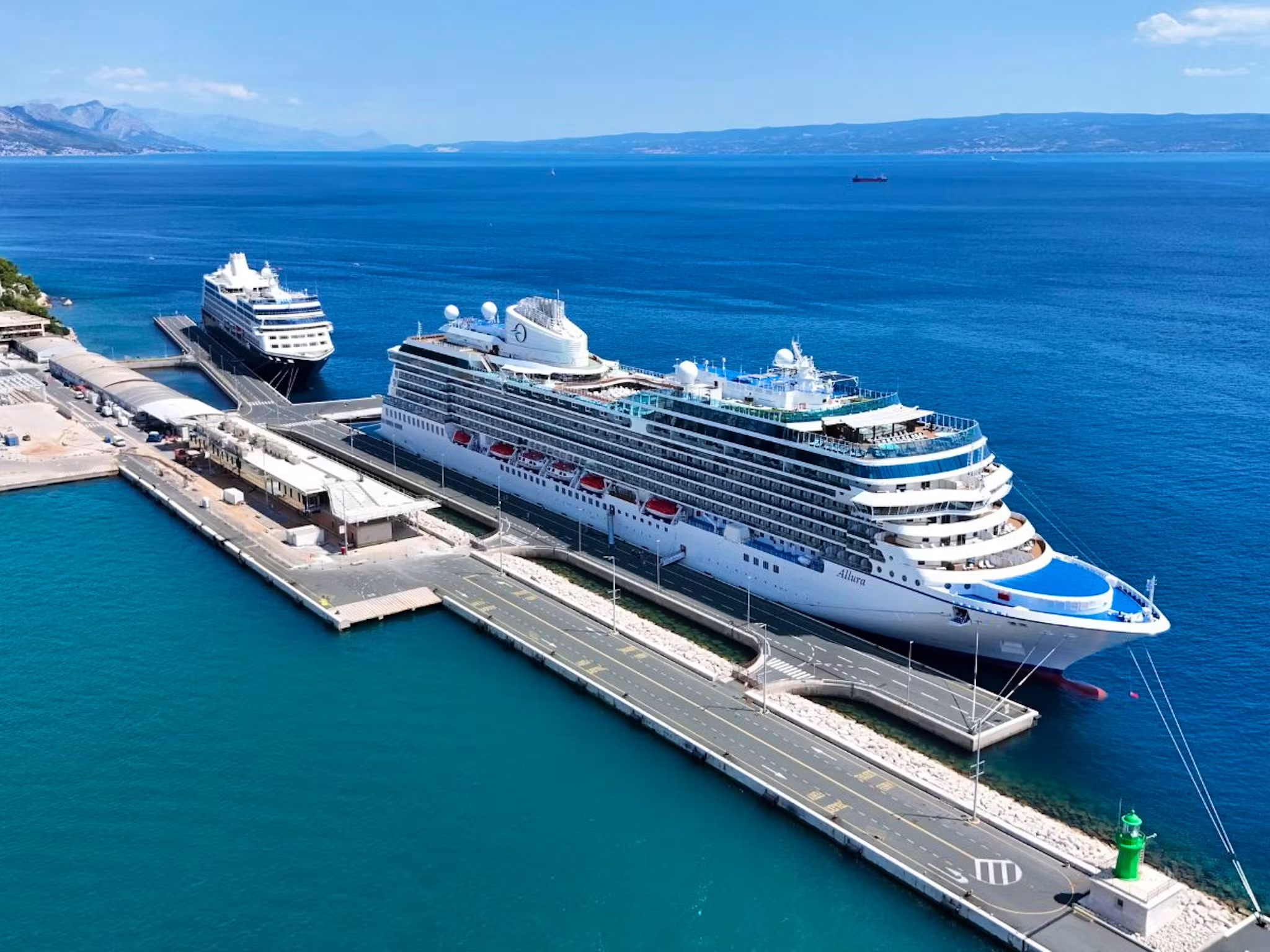
Architectural High-Tier Itinerary Engineering: Systematic Manual for Premium Global Logistics
Luxury travel planning tips. The formulation of premium international travel itineraries requires a sophisticated understanding of macro-logistics, structural risk mitigation, and spatial asset management. Within the contemporary landscape of high-tier global mobility, the procurement of premium experiences has evolved beyond simple transactional access. Wealthy individuals frequently discover that substantial financial allocation alone cannot guarantee seamless execution or personal comfort. True continuity within a complex schedule demands an analytical planning methodology that prioritizes logistical insulation over superficial prestige indicators.
Many travel itineraries are constructed using a fractured procurement model, where flights, villa rentals, and ground transport are arranged through isolated channels. This disjointed approach creates systemic vulnerabilities, as independent providers rarely communicate across corporate borders. A minor disruption in a commercial aviation link can propagate instantly through a schedule, invalidating downstream reservations and causing significant cognitive friction. Consequently, strategic planning must move toward an integrated design model that views time, geography, and support assets as interdependent coordinates.
Establishing operational resilience within a high-end itinerary necessitates moving past intuitive estimations toward rigorous, reality-based stress testing. Planners must evaluate every transition phase, localized infrastructure profile, and service delivery channel with the same precision applied to corporate risk assessments. This study provides a comprehensive exploration of elite travel architecture, offering structured frameworks, operational metrics, and adaptation strategies. These methodologies are designed to protect substantial travel investments from fragmentation while preserving the cognitive clarity of the traveler.
Understanding “luxury travel planning tips”
The strategic advice categorized under luxury travel planning tips is often reduced by consumer media to superficial checklists of elite brands and highly publicized destinations. This reductive perspective ignores the underlying microeconomics and operational complexities that govern premium travel execution. A professional definition of high-tier itinerary engineering must focus on the active reduction of logistical friction and the preservation of temporal value. The ultimate objective is ensuring that a traveler’s physical environment continuously supports their cognitive focus, privacy, and well-being.
The Problem of Fragmented Asset Acquisition
A primary structural flaw in basic travel planning is the assumption that booking high-cost assets sequentially creates a cohesive journey. When individual luxury components are acquired through independent booking engines, they remain vulnerable to systemic disconnections.
An expensive safari lodge reservation does not inherently secure a reliable regional aviation transfer if the local airstrip faces seasonal weather restrictions. Therefore, an analytical planning process must treat the connection phases between properties as distinct operational nodes rather than secondary details.
Policy Gaps and Operational Friction
Furthermore, premium travel vulnerability is heightened by a reliance on standard commercial policies that do not account for individual lifestyle requirements. High-end hospitality brands enforce rigid check-in and check-out thresholds that frequently conflict with international flight arrival patterns.
Without proactive contractual modifications or the allocation of defensive capital, travelers are often left exposed in transitional spaces. This exposure compromises personal security, forces the mismanagement of sensitive luggage assets, and generates unnecessary physical fatigue.
Preserving Human Capital and Spatial Focus
Understanding these operational variables allows planners to decouple the nominal financial cost of a booking from its actual utility. An itinerary that prioritizes geographic density over human recovery cycles introduces significant physical strain that diminishes the value of premium environments.
By analyzing how local infrastructure constraints, labor variations, and border protocols interact, planners can build protective buffers into schedules. This methodology transforms travel coordination from a series of stressful transactions into a structured discipline that preserves human capital.
Deep Contextual Background: The Industrialization of Elite Mobility

The historical trajectory of premium travel has shifted from low-velocity, seasonal migrations to hyper-accelerated, digitized global logistics. In the nineteenth and early twentieth centuries, elite travel was defined by the “Grand Tour” paradigm, where wealthy families traveled across continents for months at a time.
These journeys were executed via ocean liners and private rail carriages, which naturally built significant chronological padding into every transition. The pace was deliberate, allowing travelers to gradually adjust to changing cultural, linguistic, and environmental contexts.
The Compression of Time and Space
The mid-twentieth century introduction of commercial jet aviation and the subsequent deregulation of international airspace compressed global geography. Destinational access was democratized, which allowed corporations to establish global luxury hotel chains that guaranteed standardized comfort across diverse markets.
However, this compression of space stripped necessary transition periods out of itineraries, forcing travelers to move rapidly across multiple time zones. The margins for error within schedules were minimized to maximize aircraft and property utilization rates.
The Rise of Algorithmic Intermediaries
The modern era has been shaped by the rise of digital global distribution networks and algorithmic booking platforms.
These technologies have created an illusion of total logistical integration, encouraging independent planners to combine diverse transport modes without reviewing localized risks. Today, this digitized environment faces rising air traffic congestion, volatile weather patterns, and hospitality labor shortages. This volatile combination requires a return to deliberate, structural itinerary design to prevent high-end schedules from collapsing under stress.
Conceptual Frameworks and Spatial Mental Models
To systematically analyze and secure an upscale travel plan, specific analytical mental models must be applied during the initial design phase. These frameworks prevent emotional bias and ensure that every allocation of capital actively mitigates a known logistical vulnerability.
The Temporal Friction Index
This framework requires all movement segments to be evaluated by calculating the precise ratio between active transit time and available rest periods. A short-haul flight that requires a multi-hour terminal transfer and rigorous security processing yields a high friction index.
By mapping an entire journey across this index, planners can identify hidden points of physical exhaustion. This mapping allows them to substitute high-friction commercial legs with insulated transport alternatives, like private rail or dedicated charter aircraft.
The Asset Custody Chain Model
This model treats the traveler as an entity that must remain within continuous, high-security environments throughout their itinerary. Secure environments include private airport lounges, chauffeured vehicles, confirmed hotel suites, and monitored marine vessels.
An itinerary gap occurs whenever this custody chain breaks, exposing the traveler to unvetted public concourses or unreliable transport nodes. The objective of schedule construction under this model is to ensure that the release from one secure asset links directly to the acquisition of the next.
The Currency of Attention Framework
This mental model measures the cognitive burden imposed on a traveler by independent navigation requirements, border changes, and language barriers. High-end travel should minimize this cognitive drain, allowing the individual to direct their full attention toward professional objectives or personal recovery.
By outsourcing navigation logistics to local support networks, the planner insulates the traveler’s attention. This protection prevents the mental fatigue that often accompanies unmanaged global movement.
Key Categories of Premium Itinerary Architecture
The premium travel industry classifies itinerary structures into distinct operational categories, each presenting unique resource allocation trade-offs. Treating all high-end journeys as uniform luxury experiences leads to inefficient asset deployment and structural failure.
The Insulated Linear Expedition
This architecture is designed for long-distance transit through remote regions, relying on a single, integrated operator to manage all transport, lodging, and security details. Examples include private train journeys across continental landmasses or hyper-curated wilderness expeditions. While this model provides maximum safety and logistical continuity, it limits personal autonomy and prevents spontaneous adjustments to the route.
The Decentralized Hub-and-Spoke Configuration
This strategy involves establishing a long-term base of operations at a high-tier property within a primary metropolitan hub. Regional excursions are then executed from this node using dedicated daily transport assets.
This configuration eliminates the physical toll of frequent packaging and relocation, allowing the traveler to develop deep local familiarity. However, it requires a significant financial commitment to maintain the primary base during overnight excursions.
The Intermodal Marine-Aviation Interlock
This complex structure synchronizes private aviation arrivals with superyacht or luxury cruise embarkations, requiring precise coordination across separate transport domains. Because marine operations are highly dependent on localized port regulations, weather variations, and fuel logistics, these interlocks are structurally fragile.
A minor delay in aircraft customs clearance can disrupt port departure windows, forcing expensive re-routing or anchorage adjustments.
Evaluation of Premium Itinerary Frameworks
The table below outlines the operational trade-offs inherent in different high-tier itinerary architectures.
Realistic Decision Logic
When evaluating a multi-destination proposal, a planner must calculate the total transit time required under a worst-case scenario. If the gap between two high-cost bookings drops below the combined time of potential flight delays, customs clearance surges, and private transfers, the schedule must be rejected. The planner must then choose between extending the buffer window or consolidating the bookings under a single, highly integrated provider.
Detailed Real-World Scenarios and Operational Stress Testing
Scenario A: The Remote Wilderness Lodge Access Challenge
A traveler schedules a multi-day stay at an ultra-exclusive, fly-in fishing lodge located in a remote region of Alaska or Patagonia.
Constraints and Operational Limits
The lodge can only be reached via a single, single-engine floatplane asset that operates exclusively under visual flight rules (VFR). The international commercial arrival lands at the regional gateway airport at 1:30 PM, and the final floatplane departure is scheduled for 3:30 PM.
Decision Points and Critical Actions
The planner must decide whether to attempt the immediate transfer or build an intentional overnight stay at the gateway airport prior to lodge access.
Failure Modes and Analytical Breakdown
Choosing the immediate transfer assuming ideal weather patterns and rapid luggage reclamation represents a classic planning failure. A minor delay in commercial customs clearance causes the traveler to miss the floatplane window.
Second-Order Effects and Cascading Consequences
Because the floatplane cannot operate after dark due to regulatory limits, the traveler is stranded in a gateway town with limited high-tier lodging. The initial night at the luxury lodge is forfeited, and the entire downstream activity schedule must be renegotiated with the property’s management.
Scenario B: The Multi-Jurisdictional Mediterranean Yacht Interlock
An extended family coordinates a private superyacht charter along the Dalmatian Coast, with members arriving from three separate continents.
Constraints and Operational Limits
The yacht has secured a rare, time-limited berth in a highly regulated historical harbor that must be vacated by 4:00 PM due to local port authority laws. The final arriving flight lands at a nearby regional airport at 1:45 PM.
Decision Points and Critical Actions
The organizer must determine whether to have the yacht await guests at the main dock or instruct the captain to anchor offshore and utilize tender vessels.
Failure Modes and Analytical Breakdown
Scheduling the harbor departure within two hours of an international flight arrival leaves no margin for baggage recovery delays or traffic congestion. A single lost piece of luggage freezes the group at the airport terminal.
Second-Order Effects and Cascading Consequences
The yacht is forced to surrender its harbor berth to avoid regulatory fines, moving to an unprotected offshore anchorage. Embarkation must now be executed via small tender boats in rough seas, creating physical safety risks for elderly family members and delaying the charter’s start.
Scenario C: The High-Density European Cultural Itinerary
A private collector plans a week-long journey through major art capitals, including Paris, Florence, and Venice, to attend exclusive private viewings.
Constraints and Operational Limits
Every gallery viewing is tied to a specific, non-negotiable time slot arranged through international museum directors. Transport relies on independent high-speed rail connections booked in premium class compartments.
Decision Points and Critical Actions
The planner must decide whether to schedule consecutive viewings across different cities on the same day or limit movement to one primary city per forty-eight-hour block.
Failure Modes and Analytical Breakdown
Packing multiple viewings into a single day by relying on tight rail connections ignores the reality of urban transit friction and rail maintenance delays. A localized labor dispute on the rail network disrupts the intermediate transit leg.
Second-Order Effects and Cascading Consequences
The afternoon gallery viewing is missed, damaging the collector’s professional relationship with the curatorial team. The traveler experiences significant cognitive exhaustion, which diminishes their decision-making capacity during subsequent art acquisitions.
Planning, Cost, and Resource Dynamics
The implementation of a resilient luxury travel plan requires an honest assessment of both explicit financial costs and hidden operational outlays. Planners often focus on securing exclusive access while ignoring the defensive capital allocation required to protect those assets from external disruptions.
Direct Financial Outlays vs. Logistical Insulation Capital
Securing a premium itinerary against systemic failures demands that capital be deployed specifically for structural protection. This includes retaining private ground transport for entire days rather than individual trips, purchasing fully flexible ticket classes, and securing early-access check-in guarantees.
These protective expenditures must be viewed as an insurance premium that preserves the temporal value and comfort of the overall journey.
The Opportunity Cost of Compressed Pacing
When an upscale schedule is designed without adequate time buffers, the traveler faces a hidden cost: the loss of personal autonomy and relaxation. For a high-performing professional, a compressed schedule can lead to mental fatigue. Factoring the value of unstructured time into the planning process ensures that premium environments can actually be enjoyed, prioritizing restorative pacing over high-density scheduling.
Financial Exposure and Protection Resource Allocation
The table below demonstrates the financial and operational implications of different resource management strategies during an international transition.
Tools, Strategies, and Support Systems
1. Dedicated Local Concierge Networks
Retaining an independent, locally connected destination manager provides real-time oversight of all logistical nodes. This professional monitors regional transport updates and handles local administrative hurdles before they affect the traveler.
2. Single-Contract Interline Ticket Packaging
Constructing aviation itineraries exclusively under a single airline contract or a unified airline alliance ensures that downstream connections are legally protected. If an early flight leg is delayed, the operating carrier is required to rebook the passenger onto the next available flight at no additional cost.
3. Comprehensive Meet-and-Greet Airport Protocols
Utilizing private tarmac transfers and dedicated customs escorts minimizes security clearance delays at international transit hubs. This acceleration reduces temporal uncertainty during tight connections, protecting schedules from unexpected delays.
4. Independent Site Validation Audits
Hiring independent local experts to verify villa or yacht conditions before booking avoids inaccurate marketing depictions. This verification ensures that structural details and amenity levels match the traveler’s specific expectations.
5. Multi-Bank Financial Redundancy Systems
Maintaining active accounts across separate high-tier private banking networks ensures uninterrupted purchasing power. This redundancy protects against sudden fraud alerts or regional network communication drops.
6. Specialized Aeromedical Evacuation Memberships
Securing standalone memberships with private aeromedical extraction services guarantees immediate access to high-tier healthcare. This preparation removes reliance on local public emergency response networks in remote luxury destinations.
Risk Landscape and Compounding Failure Modes
The primary hazard when executing a high-end itinerary is the compounding nature of independent service disruptions. A single breakdown in an upscale service chain can trigger a series of failures across subsequent bookings.
The Elite Labor Shortage Loop
Modern luxury properties rely on highly trained hospitality teams to maintain their premium service standards. When a destination faces a local labor shortage, service delivery can degrade rapidly, even at elite properties. High room rates do not insulate a property from systemic labor shortages, which can lead to delayed check-ins, reduced dining options, and strained concierge services.
The Charter Cancellation Cascade
When a private marine or aviation asset experiences a sudden mechanical failure, the replacement timeline is often long due to the rarity of the equipment.
A solitary planner who has not arranged an alternative commercial routing faces the immediate loss of subsequent villa bookings and exclusive event admissions.
The Distance Support Vulnerability
Many travelers assume that high-tier credit card concierge applications can resolve any operational crisis automatically. However, these digital platforms are often managed by centralized call centers located thousands of miles from the destination. When local infrastructure failures or weather crises occur, these distant operators face the same booking systems as the public, leaving them unable to provide immediate, on-the-ground support.
Governance, Schedule Maintenance, and Active Adaptation
Maintaining an effective travel plan requires continuous monitoring and proactive adjustments as real-world conditions change. An itinerary must be viewed as a living framework that requires regular validation against local operational data.
Dynamic Itinerary Verification Windows
A professional travel plan must include pre-determined checkpoints where logistics are actively reviewed. If a luxury property changes its operating model or undergoes unannounced renovations weeks before an arrival, an adjustment trigger must be activated. Rather than hoping for the best on-site, the planner must proactively adjust the lodging choices to preserve the integrity of the stay.
Measurement, Tracking, and Evaluation Indicators
Evaluating the structural resilience of a premium travel plan relies on monitoring specific quantitative and qualitative metrics.
Quantitative Efficiency Metrics
-
The Protected Cushion Ratio: The total amount of unscheduled buffer time divided by the total number of transit nodes.
-
The Asset Exposure Index: The financial value of non-refundable, unlinked reservations that depend on a single upstream connection.
-
Service Delivery Velocity: The actual time required to resolve a service failure on-site compared to initial expectations.
Qualitative Success Signals
-
Personal Focus Integrity: Assessing whether the traveler remains relaxed and productive throughout the journey, rather than consistently stressed by logistics.
-
Autonomous Resource Flex: The ease with which an itinerary can be modified in real time without causing significant interpersonal strain.
Common Misconceptions and Oversimplifications
Myth 1: Five-Star Ratings Guarantee Impeccable Property Maintenance
A common oversimplification is assuming that a historic property’s elite rating ensures flawless technical maintenance. Many historic luxury hotels operate within aging architectural structures that are vulnerable to sudden plumbing, electrical, or climate control issues. Planners must evaluate recent guest feedback regarding physical property conditions rather than relying solely on legacy accolades.
Myth 2: Elite Credit Card Concierges Control Local Inventory
Many high-net-worth individuals believe that premium card concierges can open sold-out restaurants or fully booked boutique hotels at will. In reality, these services rely on the same primary reservation channels used by independent planners. True local access requires direct relationships with on-site operators, rather than relying on global financial customer service representatives.
Myth 3: Private Yacht Charters Can Ignore Maritime Pacing
Travelers often design yacht itineraries as if they were driving along a highway, expecting to visit multiple coastal destinations in rapid succession. Maritime travel is strictly limited by sea states, weather conditions, harbor master regulations, and fuel speeds. Forcing a captain to navigate rough waters to stick to a rigid schedule creates an uncomfortable and unsafe experience.
Myth 4: Premium Travel Insurance Covers All Out-of-Pocket Loss
The belief that an ultra-premium travel insurance policy will automatically reimburse all expenses from a missed independent connection is incorrect. Most policies require explicit, verified causes for delays to trigger payouts. If a luxury trip fails due to a poorly timed connection built by an independent planner, the insurer will routinely deny the claim.
Ethical, Practical, and Macro-Logistical Considerations
The design of luxury itineraries operates within an international travel network that faces increasing scrutiny regarding resource distribution and environmental impact. When planners arrange private charters or exclusive excursions without analyzing their local footprint, they can contribute to localized inflation and infrastructure strain. A sustainable approach to luxury travel balances personal comfort with responsible regional engagement, ensuring that high financial outlays positively impact local economies.
Furthermore, premium travel design should remain mindful of the socio-economic conditions surrounding elite properties. Staying within heavily guarded enclaves that provide no real connection to the surrounding host community can lead to isolated and fragmented experiences. Choosing properties and tour operators that prioritize fair local employment, resource conservation, and authentic cultural collaboration creates a more stable, secure, and rewarding travel environment for everyone involved.
Conclusion
Mastering the execution of high-tier global mobility requires shifting from passive luxury consumption to proactive logistical governance. By applying structured temporal models and maintaining strict asset control, planners can build itineraries that are resilient against systemic friction. True luxury is found not in the complexity of a schedule, but in the seamless continuity of the experience. Through disciplined preparation and practical risk management, a multi-destination journey shifts from an anxious race against the clock into a calm, restorative, and highly productive endeavor.